
New Castle Previous Residents by Era
One New Castle address can have several valid histories, each tied to a different time and record type. Begin with the era in question. Later property documents are easier to reach online, while older title work often moves to the Recorder counter or the state archival guide. Directories, census schedules, maps, and newspapers add a separate historical-person layer. The table keeps those routes distinct.
| Historical source | Years it reaches | Local or archive holder | What it can support |
|---|---|---|---|
| Recorder physical land records | 1849-current | Lawrence County Recorder, 430 Court Street | Instruments, parties, and legal descriptions for the local title trail |
| CountyFusion recorder documents | Approximately 1970-current | CountyFusion link from the Recorder | Later documents available for search, view, or print |
| PHMC grantor/grantee indexes | 1849-1963 | State Archives guide | An older party-index bridge when online coverage ends |
| Digitized city directories | 1872-1928 runs, with gaps | Power Library and NCPL | Dated name and address associations |
| New Castle News and marriage/obituary index | 1880-current holding and index statement | New Castle Public Library | Newspaper citations and announcement leads |
| Federal census schedules | Released schedules through 1950 | National Archives and genealogy services | Household grouping for census years |
For prior residents from a recent ownership period, begin with the current parcel and Recorder trail. For an older address question, start by identifying the best directory or map year, then test it against a deed, census, newspaper, or probate source from a compatible period.
New Castle House History Starting Point
Begin at the address as it exists today. The Lawrence County Assessment Office and GIS viewer can establish a parcel or control ID, its situs, its municipality, the current owner mailing line, and a sale or instrument reference when shown. The parcel card displays the physical Parcel Address and Owner Address separately. They may match, but they can also describe different locations and different roles.
Save the legal description whenever it is available. Street numbers can change in form, while a lot, subdivision, tax map, or legal-description clue provides a stronger bridge into prior records. For a hard match, retain the modern parcel, the older address form, cross streets, and the ward or municipality stated by the source.
Note: An assessment record supports land and ownership context, not a complete list of people at the address.
New Castle Deed Chain Backward
The Recorder's index is the ownership backbone for past-resident research, but it must be read one transaction at a time. Search the known parcel/control ID and municipality, then check the party name, recording date, document number, and legal description. A grantor is the party transferring an interest; a grantee is the party receiving it. Those roles are useful navigation markers, not proof that either party was living at the property.
- Record the current parcel/control ID, legal description, current owner and mailing information, and latest sale or instrument number from Assessment or GIS.
- Run the Recorder advanced search with the parcel/control ID, municipality, a party name, or a bounded date. Preserve the precise role and recorded date for the matching instrument.
- Obtain the newest purchase deed through the public system or Recorder counter. Capture the seller, buyer, document number, date, and legal-description wording.
- Search the seller as a prior grantee, checking the legal description and parcel rather than forcing a same-name match. Repeat backwards one transfer at a time.
- When the online run stops, move to the Recorder counter and the PHMC index route. County records reach 1849 even though CountyFusion is described as approximately 1970-current.
- Grantor / grantee
- The transferring party and the receiving party named in a recorded instrument.
- Chain of title
- A dated sequence of recorded transfers for the same property interest.
- Legal description
- The lot, subdivision, metes-and-bounds, or other recorded land description that can bridge changing street forms.
- Enumeration district
- The census area's geographic unit, useful when locating the correct census page for a dated address.
The Lawrence County Recorder advanced-search screen provides party, parcel/control, municipality, date, document, book, page, and OCR fields for this work.
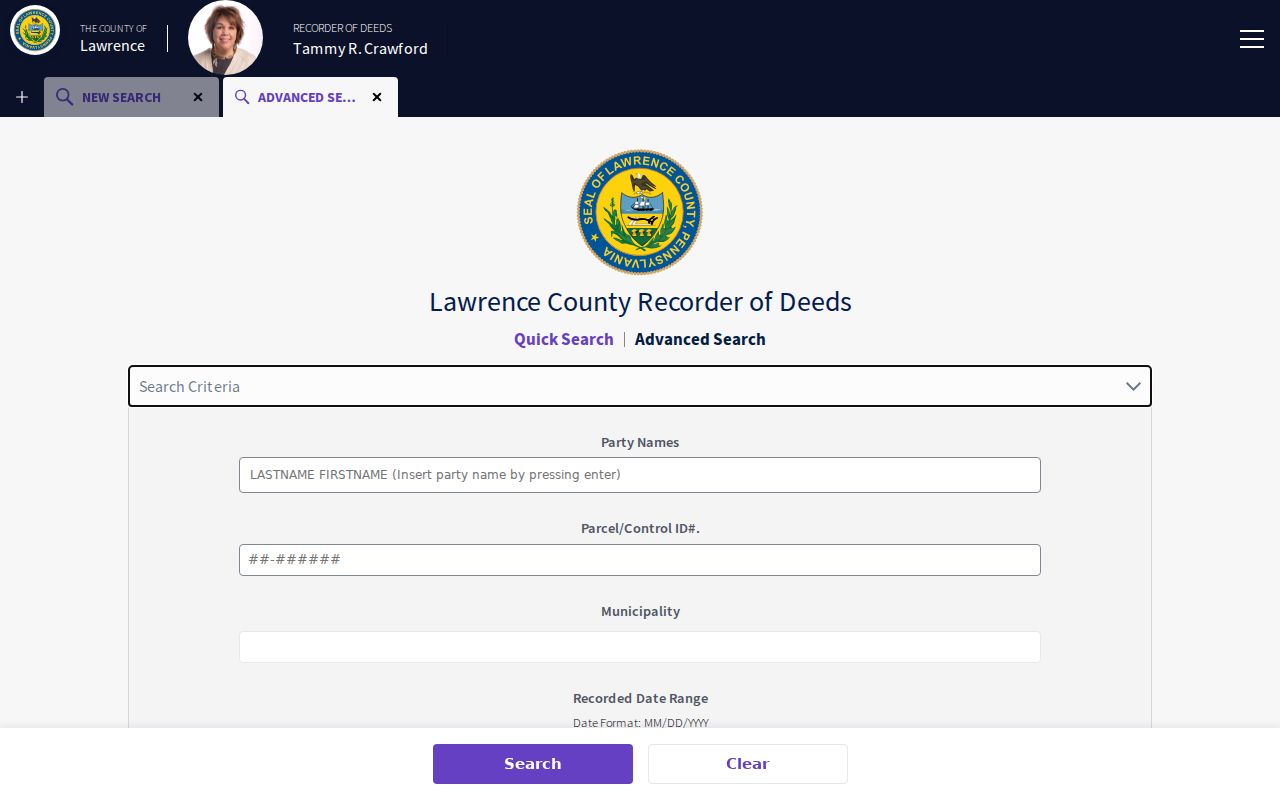
The captured interface illustrates the filters that support a recorded title trail. It does not replace checking the underlying document or the Recorder's current access rules.
New Castle Earlier House Records
Do not treat an online cutoff as the beginning of local history. Lawrence County says its Recorder office holds real-estate records from 1849, while CountyFusion handles documents approximately from 1970 forward. The PHMC guide identifies grantor/grantee index coverage from 1849-1963. That creates a handoff: use the online later document route where it reaches the question, then use the counter and archival-index path for the earlier period.
Before March 20, 1849, a local family, land, probate, or court clue may belong in Beaver or Mercer County because Lawrence County was created from those two counties. An absent Lawrence result is not proof that the person or property had no earlier history.
The PHMC county-courthouse guide provides the jurisdictional starting point for that older research.
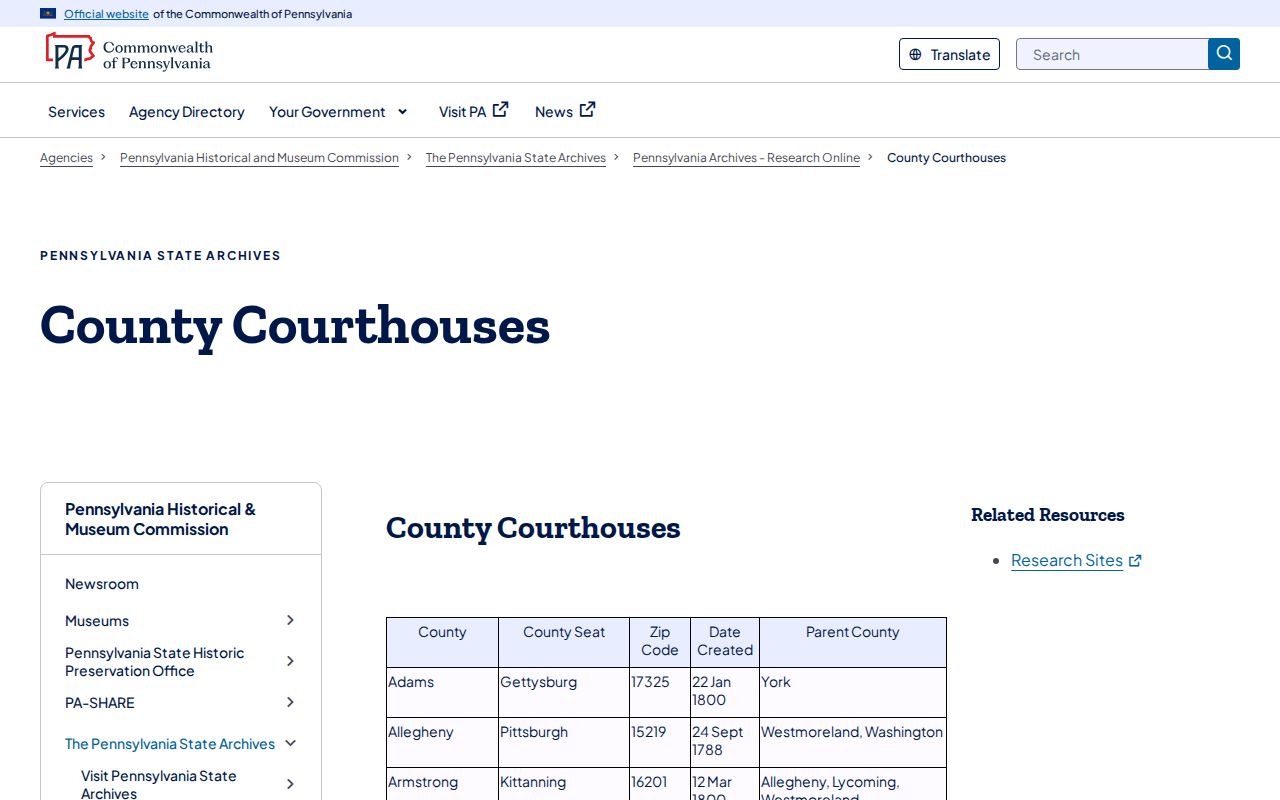
The guide is a holdings and jurisdiction aid, not a guarantee that every described volume is fully searchable online.
New Castle Address Directory Pairing
Past residents become a household question only when a dated address source is paired with another source from the same period. Power Library and NCPL provide digitized New Castle directory runs for 1872-1899, 1900-1910, 1911-1918, and 1921-1928. The runs have gaps. The inspected 1900-01 Burch directory includes a street section with blocks, house numbers, and listed occupants on both sides, but that feature cannot be presumed in every year.
The searchable 1900-01 Burch directory street section is a useful historical-address lead.
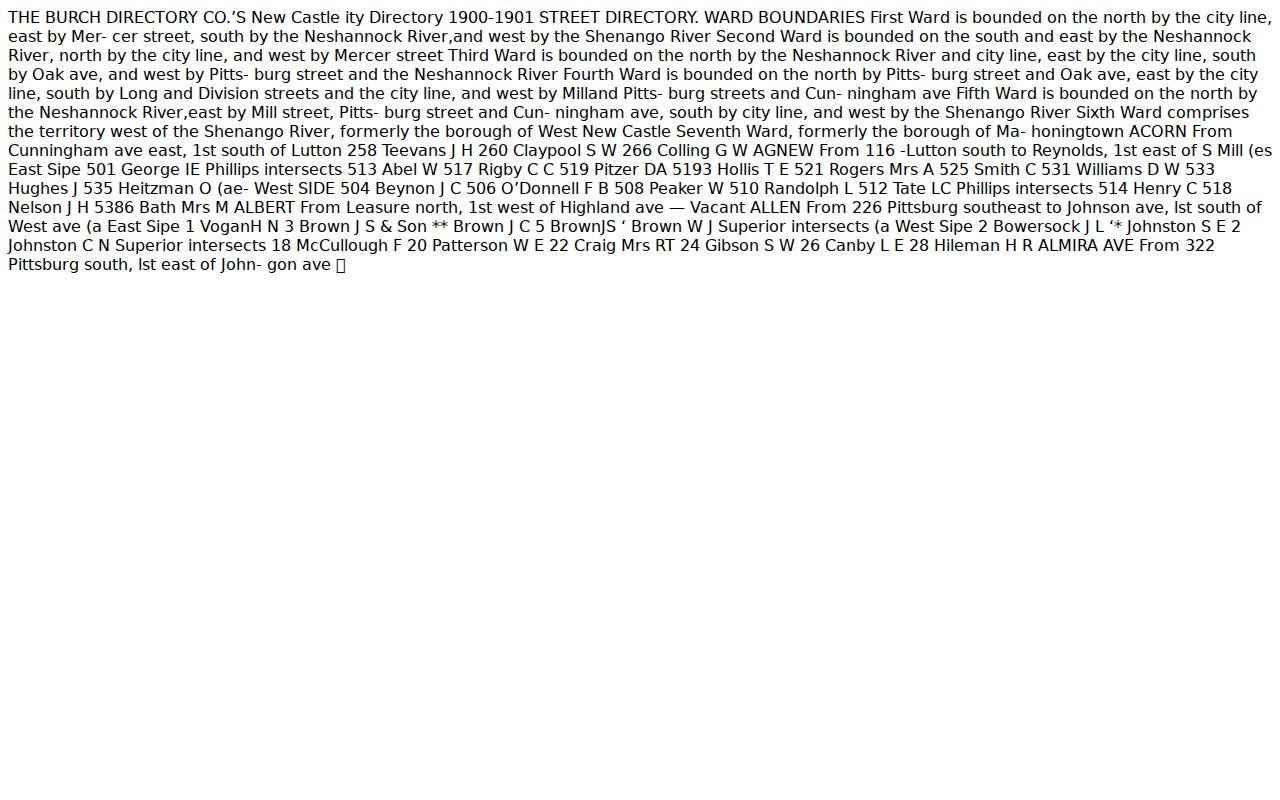
Use the edition, page, listed address, and name as a citation, then compare it with another dated source. The line is evidence for that publication year, not a statement about later residence.
New Castle Census Household Pairing
A simple process keeps directories and census evidence from drifting apart: address or legal description, then directory year, then census year, then a second local source. Work from the desired directory edition to the nearest released federal census schedule and locate the correct enumeration district before accepting a household. Federal individual schedules currently extend through 1950, and the format of older census material varies by year.
Compare names, relationships, ages, birthplace information, and location cues only where the records themselves support them. A directory may list only a householder or a name with an address. A census household may need neighborhood, street, or enumeration context before it can be linked to that directory line. This is a confirmation process, not a shortcut to a present identity claim.
Note: Keep a separate citation for the directory and census entry even when the names appear to align.
New Castle Maps for Past Residents
Maps add built-environment context to an address timeline. LCHS holds historical maps from 1885-1931, and the Library of Congress provides New Castle Sanborn maps for 1888, 1904, 1905/1955-republished, and August 1941. These sources can help test a street form, block, lot, building footprint, or surrounding development. They do not identify a resident.
A useful comparison is current parcel and legal description, then a historical map or subdivision clue, followed by a directory line from the same broad era. If the number cannot be reconciled, record that gap rather than merging two similar addresses. The Lawrence County Historical Society's maps and redevelopment-appraisal holdings are a local fallback for property context.
New Castle Past Address Breaks
Old street numbers are not a reason to force two records together. New Castle has no verified countywide renumbering year that explains every mismatch. A deed may use a lot or subdivision description, a directory may use a legacy form, and the city boundary, nearby townships, and postal labels can create ambiguity. Treat the break as a research finding until a dated source bridges it.
Lawrence County's addressing data can distinguish a current full address from a legacy full address, alongside municipality, postal community, ZIP, unit, and parcel-related fields. Use a legacy field to propose a match, then verify it with the legal description, a directory line, a recorded instrument, or a city file from the correct period. An older nonstandard number may also remain under the county's current addressing policy when it does not create an emergency-response issue.
The clearest timeline labels each link: modern situs, parcel/control ID, legal description, historical address form, directory year, and supporting source. That makes an unresolved address change visible instead of presenting a guess as a household history.
New Castle Previous Residents Notices
The New Castle Public Library's Marriage & Obituary Database is a citation finder for announcements printed in several New Castle newspapers from 1880 to the present. Search fields include last name, first name, spouse name, parent name, newspaper, and date range. Its dates are publication or announcement dates, which may differ from the marriage or death date. Use a result's newspaper and page to locate the actual notice on microfilm.
The NCPL Marriage & Obituary Database offers that citation path, while the library's Genealogy Department holds local directories, yearbooks, cemetery material, county histories, and local family histories. The historical collections themselves are described in the New Castle directory book.
For a death or estate question, an obituary, cemetery entry, probate file, and deed change are separate pieces of evidence. Check each source's date and purpose. An announcement is not a certificate, and a burial or newspaper lead does not by itself resolve a person's identity.
Lawful use. Previous-resident research belongs to house history, family history, and personal curiosity. Do not use what an address trail reveals to stalk, harass, track, intimidate, or harm a living person.