
New Castle City Directory Holdings
The strongest online shelf is the New Castle Public Library and Lawrence County Historical Society collection in Power Library. It divides digitized directory volumes into four ranges: 1872-1899, 1900-1910, 1911-1918, and 1921-1928. The first and third groups are not exhaustive. The library also keeps original directories and telephone books whose exact shelf years are not published, so an absent online year calls for a History Room inquiry rather than a conclusion that no volume exists. The Historical Society adds directories, maps, deeds, local school yearbooks, cemetery material, and county histories for a date-specific search.
| Collection | Years | Where held | Access |
|---|---|---|---|
| Digitized directory volumes | 1872-1899 | Power Library through NCPL | Online browse and search; run is not exhaustive |
| Digitized directory volumes | 1900-1910 | Power Library through NCPL | Online browse and search |
| Digitized directory volumes | 1911-1918 and 1921-1928 | Power Library through NCPL | Online browse and search; inspect the desired edition |
| Original directories and telephone books | Exact shelf years not published | Donald J. Nicolls History Room | Staff-assisted, in-room use; exact citation needed for copies |
| Local history directories, maps, and yearbooks | Varies by item | Lawrence County Historical Society | In-person research facilities |
The online end date is a digitization boundary, not evidence that printed New Castle directories ended in 1928. For a later year, ask the New Castle Public Library or the Lawrence County Historical Society to check its own holdings. Note: Keep the edition year with every result because a directory records only the time its publisher assembled that volume.
New Castle City Directory Runs
The early group includes a regional 1872-73 Shenango Valley directory that covers New Castle and nearby communities, so read the title before assigning an entry to the city itself. The 1900-01 edition identifies The Burch Directory Co. and is especially useful because the inspected volume has both alphabetical entries and a numbered street section. The later online groups contain individual editions and gaps. Opening the year card is safer than treating a range label as a promise of uninterrupted annual coverage.
Power Library’s 1900-1910 New Castle directory collection is the practical starting point for the Burch edition and other years in that range.
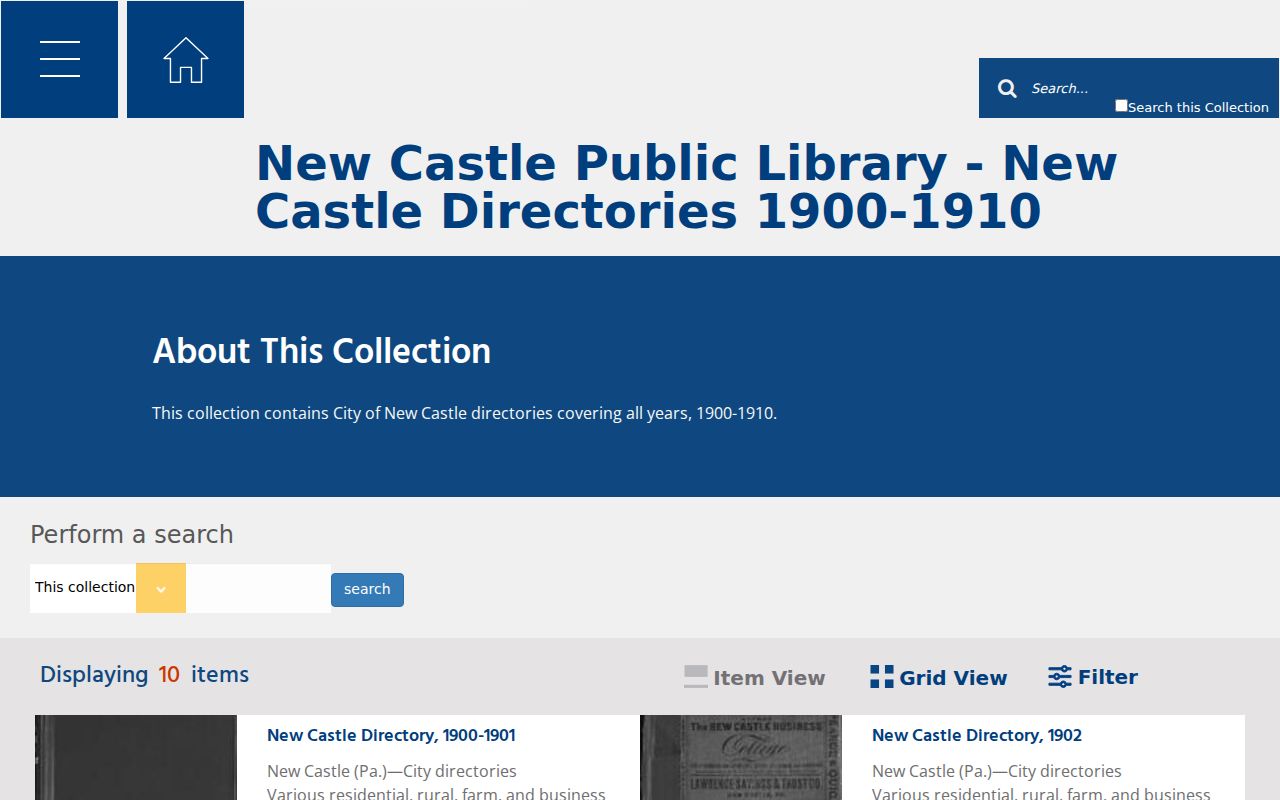
Its collection view helps separate the date range from the specific volume needed for a citation.
The collection also provides a 1921-1928 New Castle directory group for later digitized context. Use the repository’s edition-level information before comparing an address across the 1920s.
New Castle Directory Room Access
The Donald J. Nicolls History Room is on the first floor of the New Castle Public Library at 207 E. North Street. It holds local directory volumes, yearbooks, county histories, cemetery material, local family histories, and reference works. Materials stay in the room and the service is staff-assisted. The library lists general hours of Tuesday through Thursday, 10 a.m. to 6 p.m., and Friday through Saturday, 8:30 a.m. to 4:30 p.m.; contact genealogy staff before travel at 724-658-6659 extension 129 or genealogy@ncdlc.org.
For a directory, phone-book, or family-history copy, give the staff an exact citation. Requests are limited to ten pages each month, subject to condition. Limited staff research has a $5 minimum plus $1 for each additional page; microfilm copies are $0.50 per page, black-and-white copies are $0.15, and color copies are $0.50. In-library subscription access is different from a remote public database.
The New Castle Public Library Genealogy Department describes the local-history room and its contact route.
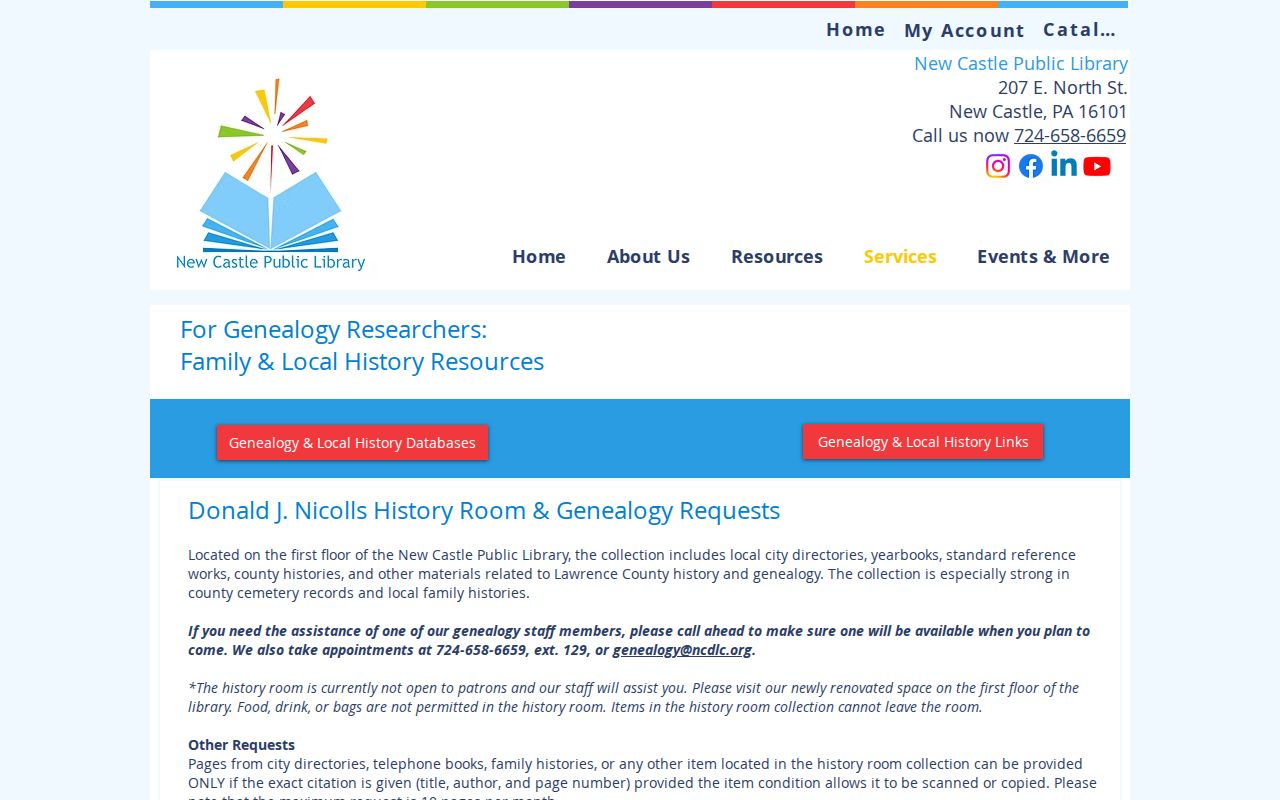
Calling ahead helps match a date or citation to the correct in-room source before a visit.
Reading New Castle City Directory Entries
An entry in one of these volumes is a compact, conditional line rather than a standard form. The visible 1900-01 alphabetical pages can show a surname, given name or initial, a spouse in brackets, widow notation, a listed activity or business location, a residence address, a rear-address notation, or a statement that the residence is the same as another address. Not every line contains every item. It does not reliably supply age, birth information, a complete household, or an address from a later year.
| Name form | Surname plus a given name or initial, sometimes with a title. |
|---|---|
| Relationship clue | A spouse may appear in brackets, and a widow notation can identify a deceased spouse. |
| Listed activity | Some entries include a role, business description, or business location. |
| Residence | A house number and street, a rear-address notation, or a residence-same linkage may appear. |
| Coverage limit | The line is evidence for that edition, not a complete household roster or present-day conclusion. |
- Criss-cross directory
- A directory arranged by street and number rather than by surname. The inspected 1900-01 edition has this type of street listing, but other years should be checked individually.
- Householder index
- A list organized around the named person heading a residence entry. It is not a guarantee that every person at the address was listed.
- Abbreviation key
- The publisher’s explanation of its shortened marks and terms. Photograph or note it when the volume supplies one, because usage can differ by edition.
The 1900-01 street-directory text records blocks, numbers, and occupants on both sides for that edition. That historical street section is useful for the same edition’s neighborhood context, not as a modern roster.
New Castle Directory Companions
Directory evidence gains strength when it is paired with a source that answers a different dated question. NCPL’s Marriage & Obituary Database indexes announcements from several New Castle newspapers from 1880 to the present. It searches by last name, first name, spouse name, parent name, newspaper, and date range. Results can show an ID, date, type, person or decedent name, spouse, parent, newspaper, and page. The date is a publication or announcement date, not necessarily the marriage or death date.
Use an uncommon surname with a date range, copy the newspaper citation, and ask for the cited microfilm page. A marriage or obituary index is a retrieval key, not a certificate or a full notice. The library’s Marriage & Obituary Database provides that citation-finding channel.
The cited newspaper page can confirm whether a directory name, spouse term, or address belongs to the same dated trail.
New Castle High School yearbooks add another dated local source. Power Library identifies Ne-Ca-Hi for 1913-1961 and Pergodian from 1962 onward. They can corroborate a name form or a school-era connection, but an old yearbook appearance does not establish a person’s current location.
A digitized New Castle yearbook item illustrates the separate school-collection route. Keep the yearbook date separate from the date of any directory or newspaper result.
Trace New Castle City Directories
For family history, begin with the closest directory edition to a known event rather than trying to make a broad name list. Record the exact page, volume, spelling, and each address. Then move backward and forward to the nearest available editions. If the volume contains a street section, compare the stated address in that same edition. A person who vanishes may have moved, died, changed a listed name, or simply been omitted. Resolve that change with a dated newspaper, census, cemetery, deed, or probate source instead of choosing one explanation.
- Search the alphabetical entry under the known spelling and reasonable variants, then note the exact edition and page.
- Transcribe each stated address, spouse term, widow notation, and listed activity without adding missing facts.
- Check that edition’s street section only when it exists, and preserve its street number and page.
- Compare nearby directory years, then pair the decade with the appropriate released federal census for household context.
- Use the NCPL newspaper citation, cemetery record, deed, or probate route to test a move, death, or estate question at a compatible date.
The historical shelf is the full context for a past address. For a present parcel or recorded instrument, use the New Castle street directory lookup route instead of treating a directory entry as current property evidence.
New Castle Directory Source Bridge
The Lawrence County Historical Society’s Medure Annex at 408 N. Jefferson Street brings together original and local sources that complement the library shelf. Its facilities hold directories, will books, deeds, cemetery and marriage records, military material, county histories, maps from 1885-1931, local-school yearbooks, and reference works. Listed research hours are Tuesday, Thursday, and Saturday, 11 a.m. to 4 p.m. Independent research is free, advance contact is advised, and the Society lists a first 15-minute staff consultation as free before staff-assistance and copy charges apply.
The Lawrence County Historical Society research facilities offer the local-source bridge when a digitized directory leaves a gap.
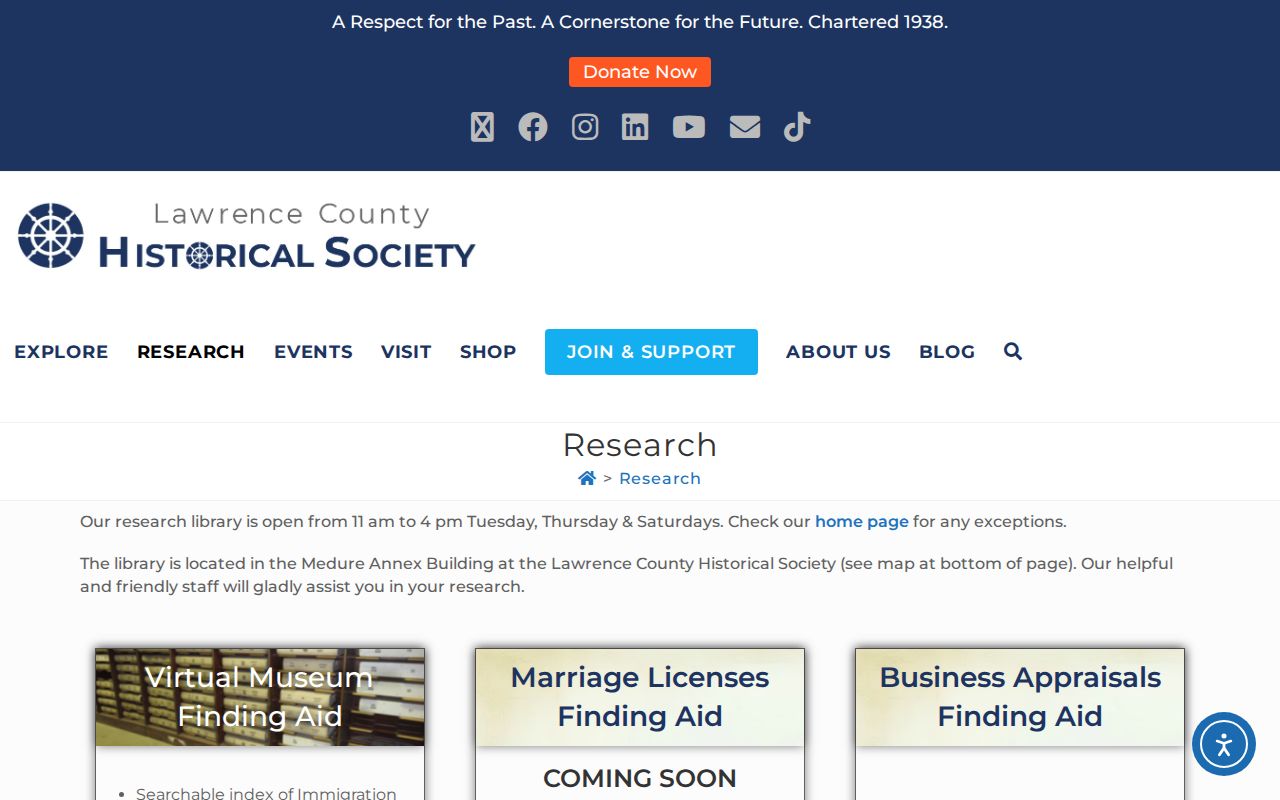
Its maps and original collections can help interpret an older address without converting that record into a claim about a present household.
New Castle Directory Jurisdiction
Lawrence County was created on March 20, 1849 from Beaver and Mercer Counties, and New Castle became the county seat. That change matters before interpreting an empty local search. A family, parcel, court matter, estate, deed, or naturalization lead from before that date may belong in Beaver or Mercer records rather than a missing Lawrence record. City directories begin later, so they are one layer in a longer historical trail.
The Pennsylvania Historical and Museum Commission’s county courthouse guide is the state starting point for that jurisdictional split.
Checking the county boundary and date first prevents a false conclusion from a later New Castle directory gap.
New Castle Directory Dates
The dates below mark documented access points, not a complete publication history. They help set a reasonable order for collection searches and prevent the digitized run from being treated as the entire record.
- 1849: Lawrence County is formed from Beaver and Mercer Counties.
- 1872-73: a Shenango Valley directory supplies an early regional New Castle source.
- 1880: NCPL’s New Castle News microfilm holding begins.
- 1900-01: the inspected Burch directory includes alphabetical entries and a documented street section.
- 1928: the last year in the documented digitized group, not a verified end to print publication.
When no volume appears online, check the History Room, the Historical Society, and the state historical-record guide before closing the search. Those routes preserve the difference between a missing scan, an unlisted shelf item, and a record that belongs in another jurisdiction.